
Experiment 1.1 introduces the reactions used to study and distinguish common classes of hydrocarbons. This revised guide preserves the original photographed solution pages while providing clearer context for first-year organic chemistry students.
Important: Use this article as a study aid—not as a replacement for your institution’s practical manual, laboratory instructions, or instructor’s guidance.
Learning Focus
- Recognize the structural features of alkanes, alkenes, alkynes, and aromatic hydrocarbons.
- Understand how prescribed chemical tests can help distinguish one homologous series from another.
- Relate observed changes to the type of bonding present in a sample.
- Write balanced reaction equations where required by the laboratory manual.
- Record observations separately from conclusions and chemical equations.
Safety Note
Perform every test only in an approved laboratory under qualified supervision. Wear the required personal protective equipment, read reagent labels and safety data, and follow your institution’s procedures for handling chemicals and disposing of waste. Bromine reagents, potassium permanganate, silver salts, copper salts, ammonia solutions, and unknown organic compounds may present significant hazards.
Do not taste chemicals or smell an unknown substance directly. Although one handwritten response refers to an aroma, learners should record only observations obtained through the safe method specified by their instructor.
Identifying a Homologous Series
A homologous series is a family of organic compounds with the same functional group and general pattern of chemical behavior. Successive members usually differ by a CH2 unit.
- Alkanes contain carbon–carbon single bonds and are described as saturated hydrocarbons.
- Alkenes contain at least one carbon–carbon double bond.
- Alkynes contain at least one carbon–carbon triple bond.
- Aromatic hydrocarbons contain an aromatic ring system and should not be assumed to react in the same way as ordinary alkenes.
Identification should be based on the complete pattern of results from the tests prescribed in the practical manual. A single observation may not be sufficient. Compare the recorded result with the expected behavior, consider possible interferences, and use structural evidence before assigning a compound to a homologous series.
Experiment 1.1: Original Solution Pages
The photographs below contain the original handwritten work for Experiment 1.1, titled Reaction of Hydrocarbons. They include proposed equations and responses involving examples such as cyclohexene, ethyne, phenylacetylene, potassium permanganate, bromine, and ammoniacal metal-salt reagents. Review every equation against your current course manual because reagent conditions, notation, and marking requirements may differ between institutions.
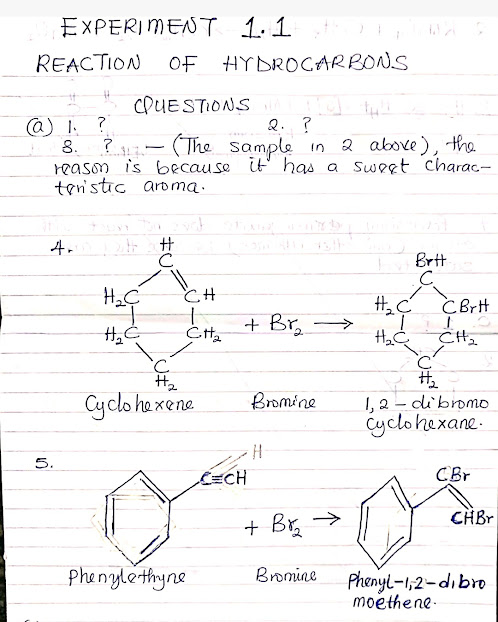
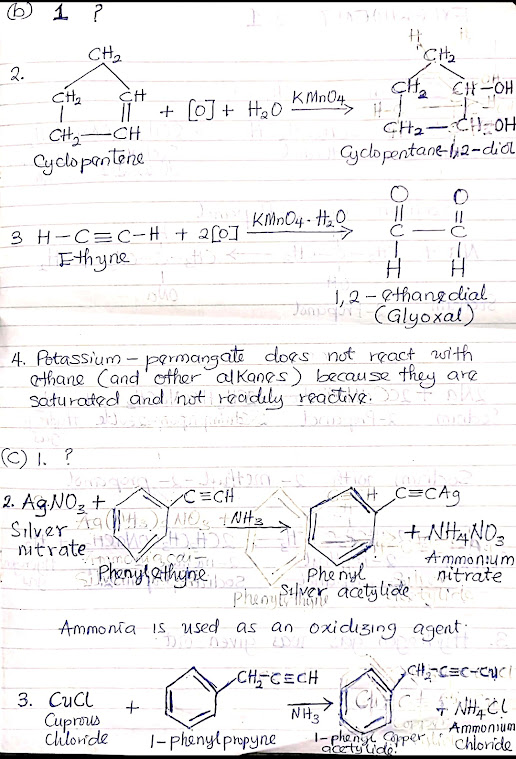
How to Use the Photographed Solution Responsibly
- Read your practical manual first. Identify the experiment’s aim, approved reagents, procedure, safety precautions, and required report format.
- Complete your own pre-lab preparation. Review the structures and expected reaction types of the hydrocarbon classes before consulting the photographs.
- Carry out only the authorized procedure. Do not reconstruct an experiment from the images or use reagent quantities and conditions that are not stated in your institution’s manual.
- Record what you actually observe. Keep observations, interpretations, and equations in separate sections. Do not copy an observation that you did not obtain.
- Compare after attempting the work. Use the photographed pages to check your reasoning, terminology, structures, and reaction equations.
- Verify uncertain answers. Handwritten solutions may contain omissions or notation that differs from your course requirements. Confirm questionable points with your instructor or an approved textbook.
- Submit original work. Explain conclusions in your own words and follow your institution’s academic-integrity policy.
Conclusion
Experiment 1.1 is intended to develop careful observation and evidence-based identification of hydrocarbon classes. The strongest practical report connects a safely obtained result to the relevant structural feature, presents the corresponding chemistry clearly, and acknowledges any uncertainty.
Explore additional learning resources on our Courses page. If you need clarification about the educational materials available on this website, please contact us.